Recycling and Waste Segregation in the Workplace. What Must Employers Provide and What Rights Do Employees Have?

Recycling and Waste Segregation in the Workplace. What Must Employers Provide and What Rights Do Employees Have?
Why does waste segregation in the workplace matter?
Workplaces generate enormous amounts of waste, often comparable to that produced in households. Paper, packaging, food waste, electronic equipment or used office materials are part of everyday reality in offices, production facilities and institutions. If these are not properly segregated, they end up in mixed waste, which significantly limits the possibility of recycling.
Waste segregation in the workplace is not only a matter of goodwill or an ecological attitude. In Poland and throughout the European Union, it is an obligation resulting from legal regulations, and responsibility for its implementation lies primarily with the employer.
How did waste segregation regulations begin in the EU and in Poland?
The first European regulations concerning waste management appeared as early as the 1970s, but a key moment was the Waste Framework Directive of 2008, which introduced the waste hierarchy: prevention, reuse, recycling, recovery and only at the very end disposal.
In Poland, a breakthrough came with the Waste Act of 2012, followed by the introduction of universal selective waste collection. Since 2021, a uniform waste segregation system into five fractions has also been in force, applying not only to households but also to companies and institutions.
The five-fraction division system
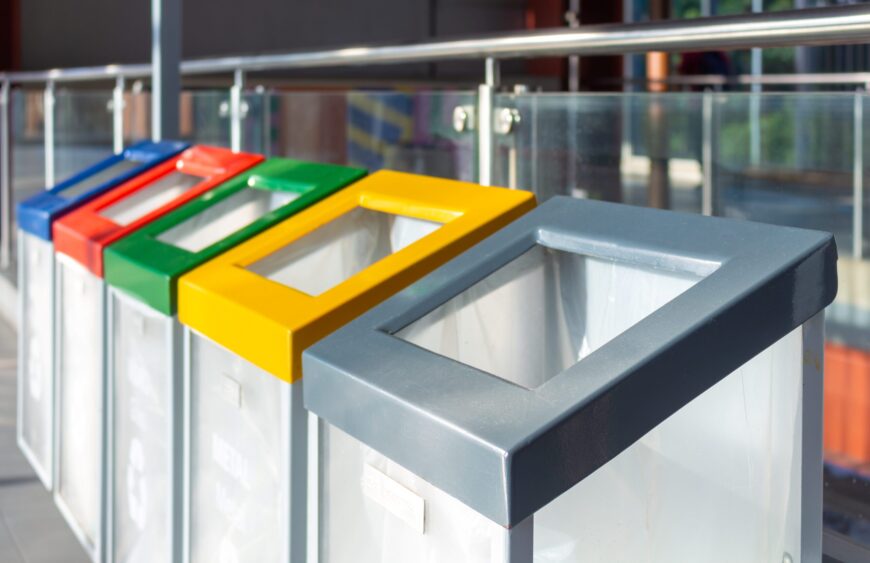
The uniform selective waste collection system is based on division into five basic fractions. This system aims to standardise segregation rules and facilitate proper waste management for both residents and companies. Importantly, it also applies to workplaces, regardless of company size or type of activity.
The first fraction is paper, collected in blue containers. It includes office paper, notebooks, newspapers, catalogues, envelopes without plastic windows and cardboard packaging. In the workplace, these are primarily office wastes, which is why proper segregation is particularly important. Contaminated, greasy paper and paper towels should not be disposed of in this fraction.
The second fraction consists of metals and plastics, marked with yellow containers. This includes plastic packaging, PET bottles, films, beverage cartons, aluminium and steel cans, as well as small metal elements. In the workplace, these are, for example, packaging from food, drinks or cleaning products. It is important that waste is emptied of its contents, although it does not need to be thoroughly washed.
The third fraction is glass, collected in green containers. This includes bottles and jars from beverages and food products. Ceramics, porcelain, tableware glass, mirrors and light bulbs should not be disposed of as glass, as they require separate disposal methods. In companies, glass appears mainly in kitchens and social areas.
The fourth fraction is bio-waste, marked with brown containers. This includes food leftovers, vegetable and fruit peelings, coffee grounds, tea leaves and other organic waste. In the workplace, bio-waste is generated mainly in kitchens and canteens. Proper segregation is crucial, as it allows composting and reduces the amount of mixed waste.
The last fraction is mixed waste, disposed of in black containers. Only waste that cannot be assigned to any of the other fractions should be placed here. Proper functioning of the segregation system means that as little material as possible ends up in mixed waste, rather than treating it as the default bin.
What obligations does an employer have regarding segregation?
According to Polish and EU regulations, the employer, as a waste producer, is obliged to ensure conditions that enable proper waste segregation. This means not only formal compliance with requirements, but also creating real opportunities for employees.
The employer should:
- provide separate containers for individual waste fractions (paper, metals and plastics, glass, bio-waste, mixed waste),
- ensure clear labelling of containers in accordance with applicable colours and segregation rules,
- organise waste collection by an authorised company,
- include specific waste types such as electronic waste, batteries, toners or fluorescent lamps in the system,
- provide employees with basic information or instructions regarding segregation.
Lack of appropriate containers or incorrect labelling may be considered a failure to fulfil statutory obligations.

Waste segregation at work and legal responsibility
Under Polish law, the employer is responsible for the way waste is managed within the company. In the event of inspections by authorities such as the Environmental Protection Inspectorate or local government units responsible for waste management, it is the company, not an individual employee, that is held accountable for irregularities.
Violations of regulations may result in:
- administrative penalties,
- fines,
- the obligation to implement corrective actions,
In extreme cases, financial sanctions provided for in the Waste Act.
Checklist. Is waste segregation carried out properly in your workplace?
The list below allows employees to independently check whether basic requirements are met:
- separate bins for different waste fractions are available in the workplace,
- containers are clearly labelled and described,
- it is known where to dispose of problematic waste (batteries, electronic waste, toners),
- containers are emptied regularly,
- employees have received any information or instructions regarding segregation,
- segregation is possible not only in the kitchen, but also in office or production spaces.
If most of these requirements are not met, there is a high probability that obligations resulting from legal regulations are not fully implemented.
What can an employee do if segregation does not work?
An employee does not bear legal responsibility for the segregation system, but has the right to point out irregularities. The best first step is to report the problem directly to a supervisor, the administration department or health and safety, preferably in a factual and specific form.
If the problem is not resolved, the employee may:
- propose simple improvements, such as labelling bins or adding missing containers,
- contact a trade union or employee representative,
- as a last resort, report irregularities to appropriate inspection authorities, such as the Environmental Protection Inspectorate.
It is worth remembering that these actions are not reporting on someone, but enforcing the law designed to protect the environment and public health.
Why segregation at work is more than just an obligation
A well-organised waste segregation system in the workplace affects not only the environment, but also organisational culture. It shows that the company treats environmental responsibility seriously and does not limit it to marketing declarations.
Waste segregation at work is a real action that reduces the amount of mixed waste, increases recycling rates and builds environmental awareness among employees. It is also one of the simplest steps from which more sustainable organisational practices can begin.
One More Tree Foundation regularly cooperates with companies and organisations, organising webinars and training sessions on recycling and ecology. In addition, we carry out clean-up actions of green areas throughout Poland, enabling volunteers and employees to clean up waste that would certainly not end up being recycled.
Related Articles
Categories
Recent Comments
Recent Posts
Tags
animal protection biodiversity climate change consumer's rights Consumerism CSR eco education ecological education ecology educational workshops electronics employee volunteering employer responsibility environment environmental protection event-cleaning event-education event-flowers event-trees event-volounteering event-volunteering flower meadow global warming labour law mental health natural environment nature phenology planting-event plants production process recycling respiratory ilnesses seasons smartphone smog spring Stellantis sustainability trash tree planting trees waste reduction waste segregation well-being